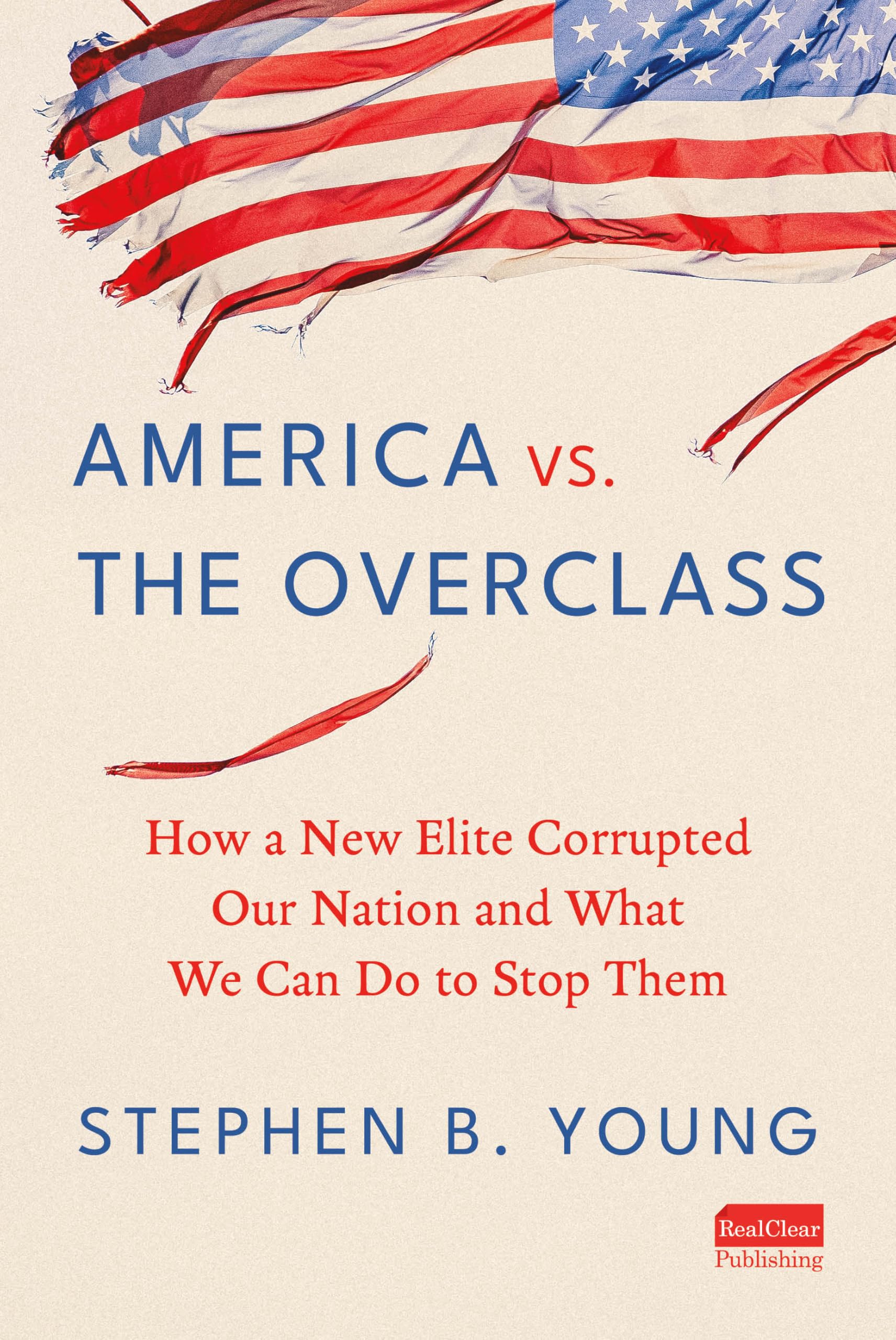
America vs. the Overclass

America vs. the Overclassicon

by Stephen B. Young

Publisher
Amplify Publishing Group
Publication
Jun 30, 2026
Format
Paperback/Softback
Illustrated
No
Price
$32.95
Dimensions
6 x 9 x 1.31 in
ISBN
979-8891384682
ASIN
B0GMS2RGF5
Pages
520
Age
Adult 18+
Category
Public Policy

Rights Sold

*DropCap does not represent Vietnamese Print language rights

Description

In the tradition of The Lonely Crowd, an ambitious sociological, psychological, philosophical, and economic analysis of the rise since the 1960s of a new American elite whose narcissism and moral corruption threaten to destroy the fabric of the nation.

In the late 1970s, Sir John Bagot Glubb published a now mostly forgotten book called The Fate of Empires and Search for Survival, which estimated that most empires do not last more than 250 years. As America approaches that auspicious benchmark, a new elite has risen to power that threatens to make the once-great country another footnote of history.

For more than 150 years, America built itself into a global beacon of power and hope atop a firmament of covenant—a sacred commitment, exemplified in the founding documents but maintained and updated through the decades, to a societal structure based on a shared sense of history and destiny. But beginning in the 1960s with the assassination of JFK and extending into the 1970s with the identity crisis brought on by the loss of the Vietnam War all the way up to today, this covenant began to fade, and a crippling sense of dysphoria began to emerge.

In America vs. the Overclass, scholar Stephen B. Young (Kissinger’s Betrayal) reveals the deep psychosocial roots and existential danger of this turn away from the covenant and the rise of a new type of American ruling-class mentality: a powerful “other-directed,” Gnostic way of thinking that has seized the levers of power from education to business to government to turn the global beacon of power and hope into a nation of narcissistic, confused, and depressed professional managers.

Drawing together threads from Jean-Jacques Rousseau to Friedrich Hegel to Karl Marx to the great thinkers of the 20th century to today, America vs. the Overclass exposes the fateful, undercover battle going on for the soul of America—and how we can restore the covenant and save our country before it’s too late.

Awards & Endorsements

Review
“The thesis of Stephen Young’s book is a simple one: America was created by a covenant. That covenant gave the country internal coherence and facilitated its growth and prosperity right up to the period after the Second World War. This covenant was progressively lost in the 1960s. Since then, America has been taken over by an elite, rent-seeking Overclass which lost its inner compass. The Trump phenomenon (both Trump One and Trump Two) was a mass reaction against this Overclass. Restoring a Covenantal America, however, requires the inner direction of Americans and their leaders to be reset. This is an arduous struggle which must be waged with persistence. The future of America depends on it. Young’s book provides historical and intellectual underpinnings for a movement of revival in America which is gathering force but still lacks clarity.”
—George Yeo, former Singapore foreign minister
Review
“In America vs. the Overclass, Stephen Young takes us on an intellectual and experiential journey that examines what is fundamentally ailing our country and what it will take to heal it. He shows his work—laying out the path that led us to our current challenges and then offering thoughtful solutions rooted in faith, personal responsibility, and a return to inner-directed values. As someone who has spent a career in criminal justice, I have seen firsthand how other-directed thinking—seeking external validation, blaming others, and waiting for systems to ‘fix’ us—keeps people trapped in cycles of harm. Stephen Young’s message is clear: We must restore inner-directed values that teach each of us we have value and that honest, respectful stewardship of our own talents can strengthen our families, communities, and nation. Regardless of whether we concur with his conclusions, this book encourages readers to present their own intellectual and experiential insights and suggest solutions that will genuinely advance the well-being of humanity. This is a timely, courageous book that calls us to reflect daily, remain humble, and pursue greatness by first improving ourselves and those who depend on us.”
—Matt Bostrom, PhD, president, Center for Values-Based Initiatives; former sheriff of Ramsey County, Minnesota; and former assistant chief of operations of the Saint Paul, Minnesota, police department
Review
America vs. the Overclass exposes why so many of our institutions falter despite being guided by capable, well-educated professionals. Stephen Young argues that higher education has largely stopped forming leaders and instead produces managers—individuals trained to assess risk and reach decisions but not inwardly prepared to act when responsibility carries personal cost. By framing leadership as a covenant rather than a contract, Young underscores why courage and interior formation are indispensable: covenants bind the self to responsibility, especially when action requires risk. The challenge Young delivers to the reader is not to do something first but to become someone capable of doing something—to reckon with one’s own ethical responsibility for the institutions one inhabits and the future one is shaping. From my work in ethical leadership and human development, I recognize how this deficit of an examined self fuels moral outsourcing and institutional paralysis, even when the right course of action is widely understood. Without inwardly formed leaders willing to bear responsibility, our social, economic, and democratic systems cannot remain sustainable.”
—Michael LaBrosse, psychotherapist; president, Leadership Solutions Internationale; former ethics and corporate social responsibility officer, First Bank System (now U.S. Bank)

Author(s)

Stephen B. Young

Stephen B. Young is the global executive director of the Caux Round Table for Moral Capitalism. He is the author of Moral Capitalism: Reconciling Private Interest with the Public Good and The Road to Moral Capitalism and has served as an assistant dean at Harvard Law School and dean and professor of law at Hamline University School of Law.

His other books include:
Kissinger’s Betrayal: How America Lost the Vietnam War; The Tradition of Human Rights in China and Vietnam (with Nguyen Ngoc Huy); The Theory and Practice of Associative Power: CORDS in the Villages of Vietnam 1967–1972; and Qur’anic Guidance for Good Governance (coeditor with Abdullah Al-Ahsan).

Related Titles

Kissinger's Betrayal
Kissinger's Betrayalicon
Stephen B. Young
ICE OUT
ICE OUTicon
Various Authors, Ian Graham Leask
Neurodiversity-Affirming Schools
Neurodiversity-Affirming ...icon
Emily Kircher-Morris, Amanda M...
Feminist Foreign Policy in Theory and Practice
Feminist Foreign Policy i...
Stephenie Foster & Susan Markham